


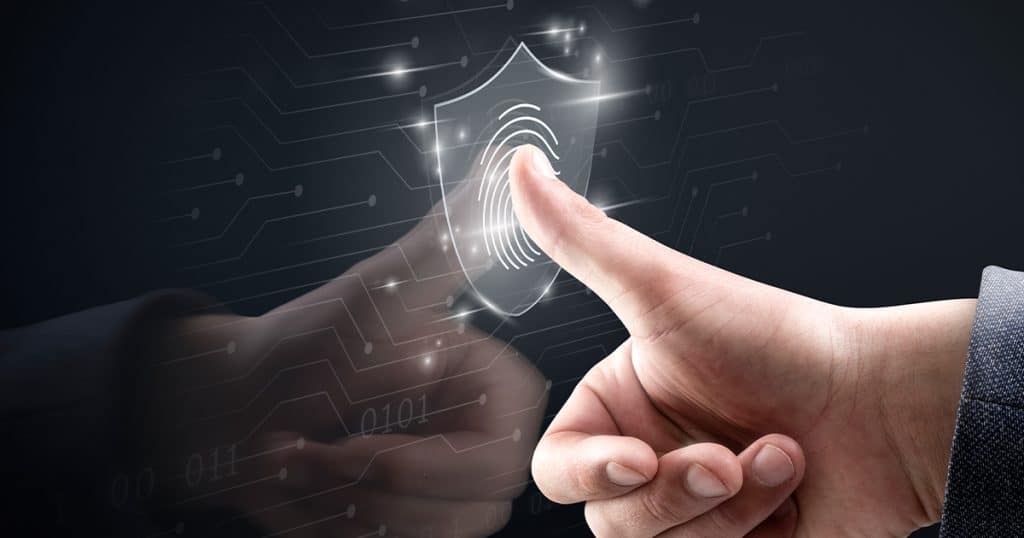
How AI Improves Authentication and Identity Verification
One of the most important ways AI works in access control is by strengthening identity verification processes.
Traditional authentication methods rely heavily on something a user knows (password or PIN) or something a user has (access card). AI introduces biometric authentication, which verifies identity using unique biological characteristics.
AI Biometric Authentication Technologies
AI enhances biometric access control by improving accuracy and reducing false matches.
Common AI-powered biometric methods include:
Facial Recognition
AI-powered facial recognition technology analyses facial features and compares them with stored data. Machine learning allows the system to recognise faces even when lighting, angles, or appearance changes.
Suggested image: facial recognition scanner
Alt text: AI facial recognition access control system
Fingerprint Recognition
AI improves fingerprint scanning accuracy by learning subtle differences in fingerprint patterns over time. This ensures reliable authentication even if fingerprints are affected by wear or minor injuries.
Suggested image: fingerprint scanner device
Alt text: AI fingerprint access control technology
Iris Recognition
Iris recognition is one of the most secure biometric authentication methods. AI maps the unique patterns of the human iris, making duplication extremely difficult.
Suggested image: iris scanning system
Alt text: AI iris recognition access control system
Liveness Detection and Deepfake Prevention
AI prevents spoofing attempts using photos, videos, or digital replicas. Liveness detection technology identifies blinking, depth, and facial movement to confirm the presence of a real person.
AI can also detect deepfake attempts, ensuring that fraudulent identities cannot bypass biometric security.
Machine Learning in AI Access Control Systems
Machine learning allows AI access control systems to improve continuously.
Instead of relying on fixed rules, AI learns from data and user behavior patterns. For example:
- Recognising employees despite hairstyle or clothing changes
- Adjusting authentication sensitivity based on environmental conditions
- Identifying normal access patterns for individuals
Over time, machine learning strengthens accuracy and reduces authentication errors.
Behavioural Analysis and Intelligent Access Monitoring
AI access control systems do more than verify identity. They also analyse behavioural patterns to detect unusual activity.
AI creates behavioural profiles based on typical:
- login times
- device usage
- building entry patterns
- access locations
Anomaly Detection
When behaviour deviates from the normal pattern, AI flags the activity as suspicious.
Examples include:
- Attempting access outside normal working hours
- Entering restricted areas without prior history
- Logging in from unusual devices or locations
AI anomaly detection improves threat identification without interrupting legitimate users.
Real Time Threat Detection in AI Access Control
One of the biggest advantages of AI in access control is real-time threat detection.
Traditional systems often detect security issues only after an incident occurs. AI continuously monitors access events and responds immediately when risks are detected.
Threats AI Can Identify
AI access control systems can detect:
- multiple failed login attempts
- stolen credential usage
- unusual access patterns
- tailgating incidents
- unauthorized entry attempts
Automated Security Responses
When suspicious activity is detected, AI can automatically:
- deny access
- request additional authentication
- alert security teams
- trigger lockdown procedures
Real-time response reduces the likelihood of security breaches.
Automated Policy Enforcement and Access Management
AI simplifies the management of access permissions by automating policy enforcement.
The principle of least privilege ensures users only have access to what they need to perform their job.
AI automatically updates permissions when:
- an employee changes roles
- a contractor project ends
- departments restructure
- risk levels change
Automated Access Reviews
AI simplifies compliance by generating audit reports and identifying unnecessary permissions.
Benefits include:
- reduced administrative workload
- improved compliance readiness
- improved visibility of access rights
- fewer human errors
Integrated Security Systems Powered by AI
AI can unify multiple security systems into one central platform.
These systems may include:
- CCTV surveillance
- biometric scanners
- alarm systems
- visitor management software
- access card systems
Integration allows security teams to monitor all access events in one place.
Benefits of integrated AI security systems include:
- faster response times
- simplified system management
- improved situational awareness
- enhanced decision-making
Context Aware Decision Making
AI access control systems consider contextual information before granting access.
Instead of relying only on fixed rules, AI evaluates factors such as:
- user role
- location
- time of request
- device used
- security risk level
Example of Contextual Access Control
In healthcare environments, AI can determine whether a medical professional should access patient records based on their department or role.
This ensures sensitive information remains protected while allowing authorised personnel to work efficiently.
Key Benefits of AI in Access Control
Implementing AI in access control provides significant advantages:
Improved Security Accuracy
AI reduces false positives and false rejections by continuously learning from data.
Proactive Threat Prevention
AI detects risks early, helping prevent security breaches.
Regulatory Compliance Support
Automated reporting simplifies compliance with industry standards.
Operational Efficiency
AI reduces manual security management tasks.
Scalable Security Solutions
AI systems adapt as organizations grow and security needs evolve.
The Future of AI Access Control
AI access control technology continues to evolve rapidly.
Future developments may include:
- predictive threat detection
- advanced behavioural biometrics
- touchless authentication
- smarter smart building integration
Organizations adopting AI-driven security solutions gain stronger protection and improved operational efficiency.
AI Access Control Consultation and Installation
Choosing the right AI access control system requires professional planning and expert installation.
Ushaka Security and Fire Projects provides tailored security solutions designed to meet specific business requirements. From consultation to installation, expert guidance ensures your system is configured for maximum performance and reliability.
Professional assessment helps determine the most suitable technologies for commercial, industrial, and corporate environments.